1
Your Cart
1
Your Cart

Salvador Dalí

Salvador Dalí – Surrealist Master of Original Prints and Lithographs, 1965

Salvador Dalí (1904–1989) was a Catalan Surrealist and one of the most influential artists of the twentieth century. Celebrated for technical precision and dreamlike imagery, he forged a distinctive visual language that bridged classical craft and avant-garde imagination.

Working across painting, sculpture, film, and especially printmaking, Dalí created landmark cycles illustrating literary classics such as Dante’s Divine Comedy, Cervantes’ Don Quixote, and Lautréamont’s Les Chants de Maldoror. These works, realized as etchings, lithographs, and wood engravings, translate his surreal iconography into finely crafted graphic art.

Dalí’s prints—often produced with leading European workshops—remain sought after by collectors for their virtuosity and narrative power. His enduring legacy as a Surrealist icon and master printmaker continues to shape modern visual culture.

Collections & Illustrated Series

Explore our collection from Dalí’s major graphic cycles:

Flordali, 1969
The FlorDali (Les Fruits) suite consists of 12 colour lithographs with drypoint etching and embossing, published in 1969.
Through anthropomorphism, Dalí transforms fruits into hybrid figures, subtly merging botanical forms with human gestures and movement. Carefully rendered branches and naturalistic details contrast with playful, dreamlike elements below. The artist turns familiar still-life motifs into surreal characters, reflecting his fascination with transformation, perception, and the relationship between organic life and the subconscious. These fantastical, anthropomorphized plants often carry humorous and subtly erotic undertones, revealing how Dalí viewed fruit as a starting point for surreal visions.
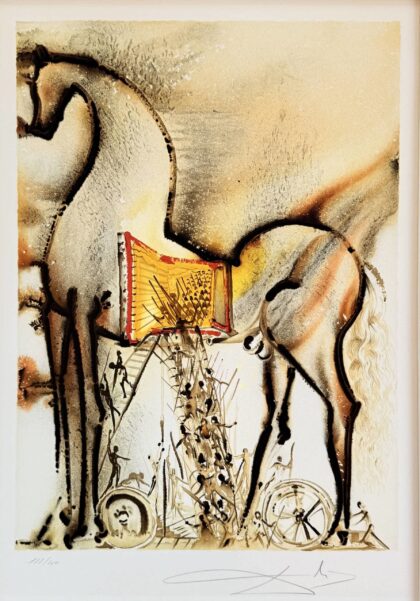
Dalinean Horses, 1970/72
Les Chevaux Daliniens (Dalinesque Horses) is a suite of 25 colour lithographs with embossing. The horse, a recurring motif in Dalí’s oeuvre, appears throughout the series as a symbol of power, dynamism, and mythic presence. Dalí’s refined lines and a restrained colour palette underline the symbolic character of the works.
The series brings together horses associated with mythological figures and legendary characters. Among them are Pegasus from Greek mythology; the Trojan Horse from Homeric legend; Rocinante, the loyal companion of Don Quixote from Cervantes’ novel; Bucephalus, the celebrated war horse of Alexander the Great, and Neptune’s mythic steed drawn from classical Roman imagery. Other compositions evoke equine figures inspired by heroic epics, reinforcing Dalí’s interest in myth, history, and symbolic transformation.
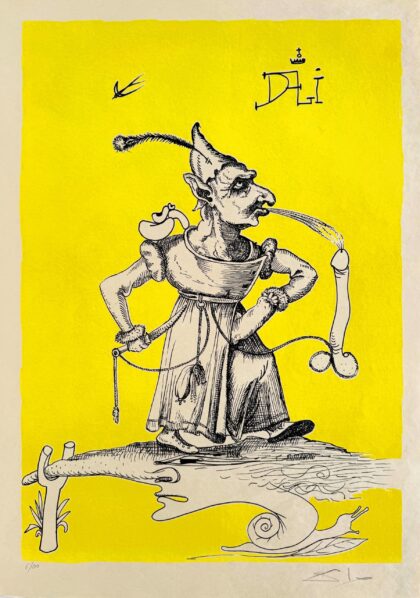
Les Songes Drôlatiques de Pantagruel, 1973
Les Songes Drôlatiques de Pantagruel is a suite of 25 colour lithographs, published by Carpentier in 1973. The title refers to the Renaissance world of François Rabelais, author of the Pantagruel stories, celebrated for their humour, exaggeration, and fantastical transformations. Drawing inspiration from 16th-century imagery, Dalí reinterpreted these grotesque figures through his own surrealist vision. The suite is characterized by theatrical poses, hybrid human-animal forms, and tall, elongated characters, reflecting both playful satire and the absurdity of social roles.
After 50 Years of Surrealism, 1974
The suite comprises 12 colour etchings with stencil on Arches paper, published in 1974 by Transworld Artl. The series reflects Dalí’s personal vision of Surrealism. Although the Surrealist movement emerged in the 1920s and Dalí was later expelled from the group in the 1930s, he eventually redefined his place within the movement and is now regarded as one of the most significant Surrealist artists of the 20th century.
Each work in the series reflects a different aspect of Dalí’s surrealist journey. One of the compositions, Picasso: Ticket to Glory, serves as a homage to Pablo Picasso following his death, depicting a sorrowful Salvador Dalí bidding farewell to the artist.
Poèmes Secrets, 1967
Secret Poems by Apollinaire is a series consisting of 18 colour etchings enhanced with watercolour, of which 10 are vignettes. Published in Paris by Pierre Argillet in 1967.
Salvador Dali created this cycle inspired by poetry of Guillaume Apollinaire, a writer closely linked to early Surrealist ideas. Apollinaire’s poetry mixes erotic symbolism, dreamlike imagery and modernist experimentation. Dalí illustrates the poems through floating figures, delicate lines, and symbolic gestures, translating the poetic language of Apollinaire.
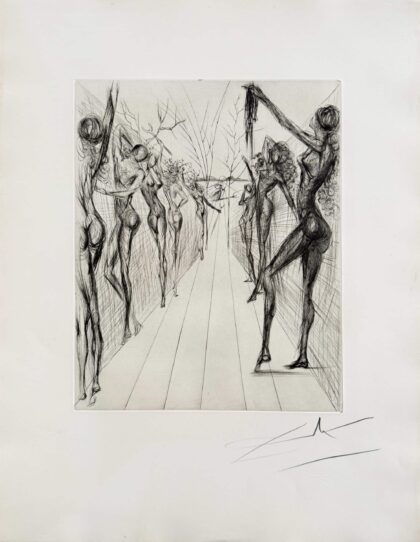
Venus aux Fourrures, 1969
Venus in Furs comprises 20 colour drypoint etchings with roulette, of which 4 our vignettes published in 1969. This edition is enhanced with watercolour, published on Japon paper.
Salvador Dalí illustrated the novel Venus in Furs, written by Leopold von Sacher-Masoch, a 19th-century psychological work exploring themes of desire, power, and control. The narrative revolves around an idealized feminine figure and reflects on the delicate boundary between imagination and lived experience.
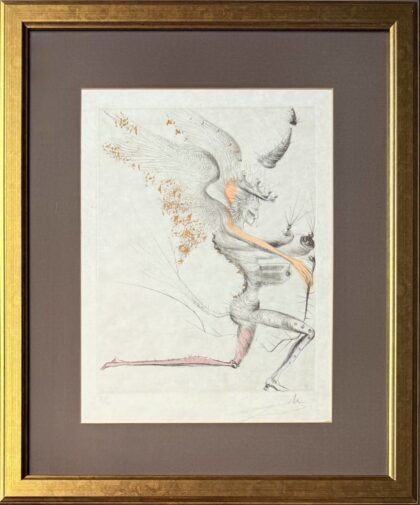
Faust, 1969
Salvador Dali illustrated a literary masterpiece Faust by German writer Johann Wolfgang von Goethe in 1969.Comprising 21 original etchings created using ruby- and diamond-tipped roulette techniques of which 10 are vignettes. Published in Paris by Pierre Argillet in 1968-1969.
Faust tells the story of a restless thinker who enters a surreal journey. The narrative explores themes of desire, temptation, spirituality, and the limits of human ambition. This blend of fantasy, transformation, and psychology made it a natural subject for Dali.

Published in Paris by Pierre Argillet between 1969 and 1970, The Hippies is among Salvador Dalí’s most lyrical late graphic suites — a visionary interpretation of the 1960s spirit of freedom and inner transformation. The portfolio comprises eleven drypoint etchings with hand coloring, printed at Atelier Robbe on Arches and Japon nacré paper.
The tirage consisted of 245 examples plus 24 proofs: impressions numbered 1/145–145/145 on Arches, and deluxe copies marked I/C–C/C on Japon nacré. Each work is hand-signed in pencil by the artist and bears his blindstamp, testifying to the close collaboration between Dalí and his publisher Pierre Argillet.
In this series, Dalí transforms the countercultural ethos of the late 1960s — love, spirituality, and the search for transcendence — into a private mythology of metamorphosis. Human forms merge with air, water, and light, reflecting the passage from material existence to the realm of imagination. Technically refined and visually meditative, the suite bridges surrealism and the age of psychedelia, capturing an era’s utopian longing through Dalí’s timeless dream language.
The Hippies stands as a testament to Dalí’s enduring fascination with the invisible — a vision where body and spirit dissolve into one luminous, boundless continuum.
The Hippies, 1969-70
Les Vitraux du Musée de Salvador Dalí à Figueres, 1973
(The Stained Glass Windows of the Salvador Dalí Museum in Figueres)
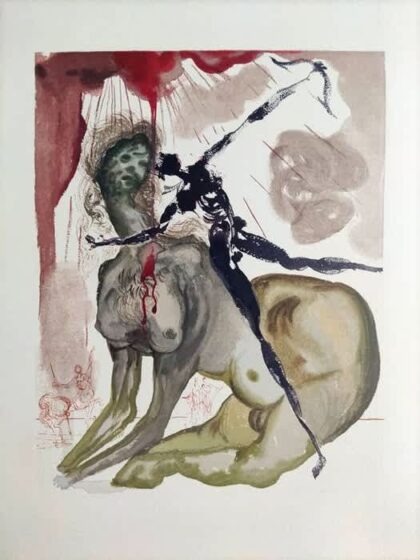
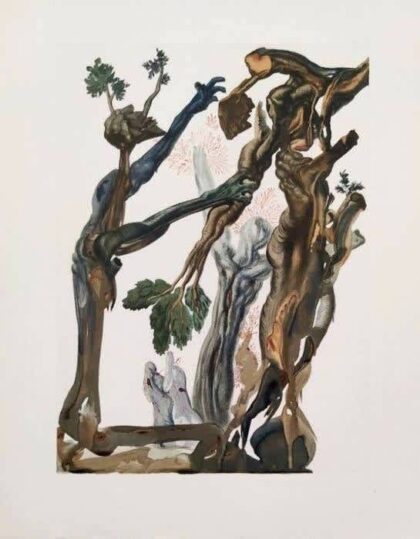
Divine Comedy, 1960
In 1950, on the occasion of the 700th anniversary celebrations dedicated to Dante Alighieri, Salvador Dalí — a Spanish artist — was commissioned by the Italian government to illustrate The Divine Comedy. The decision sparked considerable controversy within Italy, and the project was ultimately withdrawn. By that time, however, Dalí was already deeply engaged with the series and chose to continue independently, later collaborating with a French publisher and master engravers to produce a suite of 100 colour woodcuts. The complete series was eventually published in 1960, presenting Dalí’s reinterpretation of Dante’s spiritual journey from Inferno through Purgatory to Paradise, and comprising a total of six volumes.
Japanese Fairy Tales, 1974

Japanese Fairy Tales is a rare and beautifully crafted portfolio of ten original etchings with stencil color (Rigal), created through a collaboration between Gerschmann, Stockholm and Yayoi, Tokyo. Printed in a limited tirage of 300 copies on fine Arches and Richard de Bas paper, this collection unites exquisite craftsmanship with timeless storytelling. Each etching measures approximately 48 × 38.3 cm and showcases the precision, color, and balance that define modern printmaking at its finest.

The portfolio visualizes ten iconic stories from traditional Japanese folklore, merging narrative depth with refined artistic technique. Each etching celebrates a classic tale known for its moral, symbolism, and cultural resonance:

  1. Momotaro (Peach Boy) – the brave child born from a peach who defeats demons with courage and loyalty.
  2. Hagoromo (The Robe of Feathers) – a celestial maiden’s tale of love, loss, and the link between heaven and earth.
  3. Urashima Taro – the fisherman who visits an underwater kingdom and discovers time’s mysterious passage.
  4. Hanasakaji San (The Old Man Who Made Trees Blossom) – a story of kindness rewarded through nature’s magic.
  5. Rokujiso (The Grateful Statues) – a parable of compassion and gratitude that transcends the material world.
  6. Kumo (The Weaver Spider) – a poetic reflection on patience, artistry, and fate.
  7. Kosonaga Chojo (The Princess and the Herd Boy) – the romantic legend of two lovers separated by the Milky Way.
  8. Jugoyoe – a mysterious narrative evoking Japan’s spiritual traditions and moonlit myths.
  9. Shunboshi (Little One-Inch) – the miniature hero who triumphs over challenges with wit and courage.
  10. Shitakiri (The Tongue-Cut Sparrow) – the moral tale of greed and humility, reminding viewers of life’s true values.

These Japanese etchings preserve Japan’s ancient tales through a Western fine-art technique, harmonizing Japanese folklore with European printmaking mastery. The collaboration between Yayoi Tokyo and Gerschmann Stockholm bridges cultures, offering a collection that is both visually refined and emotionally timeless.

Each print in Japanese Fairy Tales serves as a poetic interpretation of universal themes — courage, compassion, love, and humility — making this portfolio a cherished example of cross-cultural art and a lasting celebration of storytelling through the art of etching.

Images will be added soon

The Zodiac II, 1974
The Zodiac II is a refined portfolio of twelve original etchings with color, created from a single original drawing and published by Leon Amiel in Paris and New York. Each etching measures approximately 21.2 × 18 cm on a sheet of 35 × 26.2 cm and reflects the enduring dialogue between art and astrology. Printed in a limited tirage of 550 copies plus E.A., the edition includes impressions on Guarro and Japon paper, each sheet bearing the blind stamp LA as a mark of authenticity and quality. The portfolio visualizes the twelve astrological signs, transforming celestial archetypes into symbolic compositions of line, balance, and tone:
  1. Aries – symbol of initiative and vitality.
  2. Taurus – representing stability and endurance.
  3. Gemini – sign of intellect and communication.
  4. Cancer – reflecting emotion and protection.
  5. Leo – emblem of strength and creativity.
  6. Virgo – linked to observation and discipline.
  7. Libra – symbol of harmony and proportion.
  8. Scorpio – embodying intensity and transformation.
  9. Sagittarius – associated with exploration and philosophy.
  10. Capricorn – expressing ambition and perseverance.
  11. Aquarius – figure of innovation and progress.
  12. Pisces – connected to imagination and empathy.
Each etching in The Zodiac II presents a visual meditation on the passage of time, human character, and cosmic order. The collection unites technical precision with symbolic depth, demonstrating the publisher’s dedication to fine printmaking. The series stands as a testament to Leon Amiel’s vision, integrating modern etching techniques with the universal imagery of astrology. Through elegant composition and subtle color, these works bridge mythology, psychology, and art, offering a timeless interpretation of the zodiac that continues to resonate with collectors and scholars alike.
Looking for a specific Salvador Dalí work? Share your criteria below.
We respond promptly with available works and tailored suggestions.


Collectors Also Explore

Dive into the works of the artists that naturally connect with each other.

Portrait of Pablo Picasso promoting original lithographs and aquatint etchings
Pablo Picasso
Georges Braque 1908 photograph published in Gelett Burgess The Wild Men of Paris Architectural Record May 1910 1
Georges Braque
Portrait of Joan Miro Barcelona 1935 June 13 1 1
Joan Miró
marc chagall paris portrait 1921
Marc Chagall